


Panel Discussion about Inter-Parliamentary Cooperation Tools for the Implementation of Artificial Intelligence in Parliaments
How it was
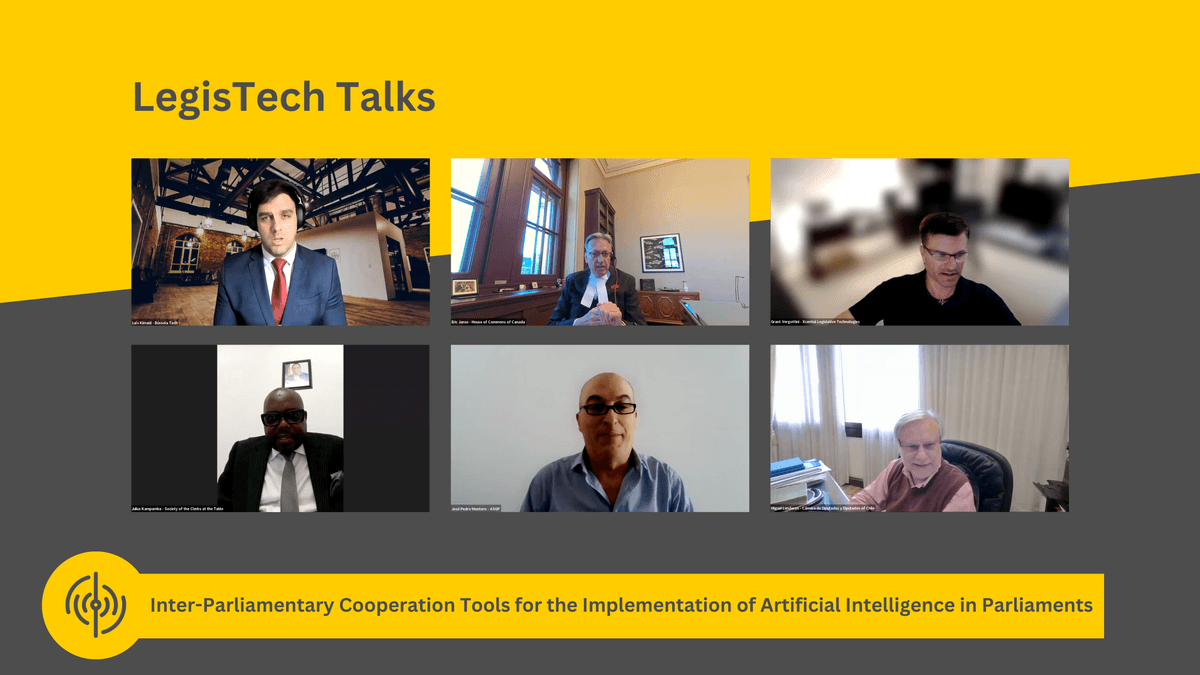
On November 6th, 2025, Bússola Tech convened a panel discussion titled “Inter-Parliamentary Cooperation Tools for the Implementation of Artificial Intelligence in Parliaments,” bringing together senior parliamentary leaders, inter-parliamentary representatives, and a private-sector standards pioneer to examine how structured cooperation can accelerate responsible AI adoption across legislative institutions.
Moderated by Luís Kimaid, Executive Director of Bússola Tech, the panel featured Eric Janse, Clerk of the House of Commons of Canada; Grant Vergottini, CEO of Xcential Legislative Technologies; José Pedro Montero, President of the Association of Secretaries-General of Parliaments; Julius Kampamba, Team Lead of the Technical Team of the Society of Clerks at the Table (Africa); and Miguel Landeros, Secretary-General of the Cámara de Diputadas y Diputados of Chile.
The discussion centred on a strategic question: how can existing instruments of parliamentary diplomacy be mobilised to disseminate practical knowledge on artificial intelligence? Rather than focusing narrowly on specific AI tools, participants examined cooperation architectures — professional associations, bilateral exchanges, regional forums, standards bodies, and technical networks — as the real enablers of sustainable transformation.
A central theme was differentiation. Not all parliaments begin from the same level of digital maturity. Speakers emphasised that cooperation must be calibrated to institutional capacity: advanced legislatures may collaborate on cloud architectures, structured data standards, and governance frameworks, while smaller or less digitised parliaments may benefit first from targeted digitisation support, lightweight AI pilots, and foundational infrastructure guidance. Inter-parliamentary cooperation was therefore framed as adaptive, not uniform.
Several durable instruments were highlighted. Staff secondments and technical shadowing arrangements were described as particularly effective, allowing parliamentary officials to observe AI deployment in real operational environments. Standing professional networks — such as associations of clerks and secretary-generals — were presented as platforms for sustained dialogue beyond episodic conferences. Joint workshops, sub-regional seminars, and structured reporting mechanisms were also identified as mechanisms that transform awareness into institutional uptake.
The private-sector perspective underscored the importance of shared data standards and interoperability. As legislative information increasingly becomes machine-consumed rather than paper-read, collaboration on structured data formats and publishing practices becomes essential. Artificial intelligence systems depend on coherent, standardised legislative data; without coordinated efforts, fragmented publication models risk undermining accuracy and public trust.
The panel also addressed the evaluation of cooperation initiatives. Rather than relying solely on quantitative metrics such as number of events or participants, speakers pointed to qualitative indicators: continuity of engagement, institutional adoption of shared guidelines, replication of successful models, and the emergence of joint projects. The effectiveness of parliamentary diplomacy in the AI domain, they argued, should ultimately be measured by internal transformation within participating institutions.
Throughout the discussion, artificial intelligence was consistently framed as an instrument in service of democratic strengthening. Whether through enhanced citizen accessibility, improved legislative oversight, structured publication of parliamentary data, or more efficient internal workflows, cooperation was portrayed as a multiplier: enabling parliaments not merely to experiment with AI, but to integrate it responsibly within constitutional mandates.
In conclusion, the November panel reaffirmed that the implementation of artificial intelligence in parliaments is not primarily a technological challenge, but a cooperative one. When inter-parliamentary networks move from occasional exchanges to structured, continuous collaboration — grounded in standards, shared governance principles, and peer learning — they create the conditions for AI adoption that is coherent, ethical, and institutionally resilient.
Strategic Partners
Privacy Policy