


Event about Digital Agenda in Parliaments at the U.S. House of Representatives and the Organization of American States (OAS)
How it was
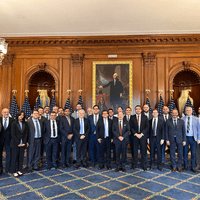
Bússola Tech, in collaboration with the Organization of American States (OAS), hosted the “LegisTech: Digital Agenda in Parliaments” conference on May 8th and 9th, 2025, in Washington, DC. Held at the U.S. House of Representatives and the Organization of American States, the event convened Members of Parliament, senior parliamentary officials, parliamentary administrators, and technology experts from across the Americas, Europe, and Asia to discuss the strategic development of digital agendas in legislative institutions.
The conference focused on the role of digital transformation and artificial intelligence in strengthening parliamentary efficiency, institutional resilience, transparency, cybersecurity, and citizen engagement. Across two days of presentations and panel discussions, participants examined governance frameworks, implementation strategies, and practical use cases for digital technologies within legislative environments.
The opening session on May 8th featured Luís Kimaid, Executive Director of Bússola Tech, and Moises Benamor, Chief of Representative Institutions at the Organization of American States (OAS). This was followed by opening presentations by each delegation on “The Role of the Digital Agenda in Parliaments of the Future”. Speakers included Stephanie Bice, Chairwoman of the Subcommittee on Modernization of Congress at the U.S. House of Representatives; Grant Vergottini, CEO of Xcential Legislative Technologies; Ed Malaga, Member of Congress of Peru; Juan Carlos Montoya, Vice-President of the Inter-American Commission of Science and Technology of the OAS; Marcos Aquino, CEO of Ágape Consulting; Juliano Bringer, CIO of Ágape Consulting; Eric Aedo, Vice-President of the Cámara de Diputadas y Diputados of Chile; Karim Bianchi, Senator of the Senado de la República of Chile; Federico Döring Casar, Member of the Cámara de Diputados of Mexico; and Brahma Mishra, CEO of MeetMonk.
The first panel discussion, “The Future of Parliaments: What Does Parliamentary Representation in the Future Look Like?”, was moderated by Luís Kimaid and featured Eric Aedo, Vice-President of the Cámara de Diputadas y Diputados of Chile; Federico Döring Casar, Member of the Cámara de Diputados of Mexico; and Grant Vergottini, CEO of Xcential Legislative Technologies.
The afternoon sessions addressed cybersecurity concerns in parliaments, with a panel moderated by Moises Benamor and contributions from Kerry-Ann Barrett, Chief of the Cybersecurity Section of the Inter-American Committee against Terrorism (CICTE); Ed Malaga, Member of Congress of Peru; and Karim Bianchi, Senator of the Senate of Chile. The programme also included an official visit to the floor of the U.S. House of Representatives and a formal photo session at the Rayburn Room.
A dedicated session presented the book “Artificial Intelligence in Legislative Services: Principles for Effective Implementation”, featuring Luís Kimaid, Wade Ballou, Legislative Counsel of the U.S. House of Representatives (retired); Fotis Fitsilis, Head of Department of Scientific Documentation and Supervision at the Scientific Service of the Hellenic Parliament; Grant Vergottini, Moises Benamor and Brahma Mishra.
The final panel of the first day, “Using Artificial Intelligence to Improve Participation and Citizens’ Oversight in Parliaments”, included Luís Kimaid; Fotis Fitsilis; Kyoungshin Kim, Director of the Inter-Parliamentary Bureau at the National Assembly of the Republic of Korea; Bruno Thomasi, CEO of GovSys; and Daniel Schuman, American Governance Institute.
The second day, May 9th, held at the Organization of American States, focused on case presentations on the use of artificial intelligence in parliaments. Presentations were delivered by Stephen Dwyer, Senior Innovation Director at the U.S. House of Representatives; Danilo Aguiar, Secretary-General of the Senado Federal of Brazil; Marcos Aquino, CEO of Ágape Consulting; Juliano Bringer, CIO of Ágape Consulting; Miguel Landeros, Secretary-General of the Cámara de Diputadas y Diputados of Chile; Juan Oses, Director of International Relations of the Senado de la República of Chile; Grant Vergottini, CEO of Xcential Legislative Technologies; José Andrés Jiménez Martín, Head of the ICT Technical Advisory Department of the Congreso de los Diputados of Spain; Javier de Andrés Blasco, Adviser to the Secretary-General of the Congreso de los Diputados of Spain; Brahma Mishra, CEO of MeetMonk; Kyoungshin Kim, Director of the Inter-Parliamentary Bureau of the National Assembly of the Republic of Korea; Bruno Thomasi, CEO of GovSys; Alexandre Bess, CEO of Legalbot; Fotios Fitsilis, Head of Documentation at the Hellenic Parliament; and Cathy Pagano, iLegis.
The afternoon panels addressed the alignment between modernisation strategies and parliamentary rules of procedure, moderated by Moises Benamor, with Stephen Dwyer, Fotis Fitsilis, and Luís Fernando Pires Machado, Adviser at GovSys. This was followed by a panel on the use of generative artificial intelligence for procedural and legal advice, moderated by Luís Kimaid, and featuring Miguel Landeros; Kirsten Gullickson, Director of Systems Analysis and Quality Assurance at the Office of the Clerk of the U.S. House of Representatives; Danilo Aguiar; and Grant Vergottini.
The final sessions focused on preparing parliaments for digital legislative processes and machine-readable information, with contributions from Wade Ballou; Javier de Andrés Blasco; Jordan Wilson, Director of Member Services, Modernization & Innovation at the U.S. House of Representatives; Juan Oses; and Marcos Aquino. The closing panel, “The Anticipated Impact of Artificial Intelligence on Enhancing Legislative Openness and Comprehensibility”, was moderated by Luís Kimaid and included José Andrés Jiménez Martín; Warren Burke, Chief Legislative Counsel of the U.S. House of Representatives; and Alexandre Bess.
The conference concluded after two days of substantive discussions and exchanges, reinforcing the importance of coordinated digital agendas, institutional governance, and international cooperation in advancing the digital transformation of parliaments worldwide.
Strategic Partners


Privacy Policy