


Panel Discussion about How Is Artificial Intelligence Enhancing the Efficiency of Parliamentary Transparency?
How it was
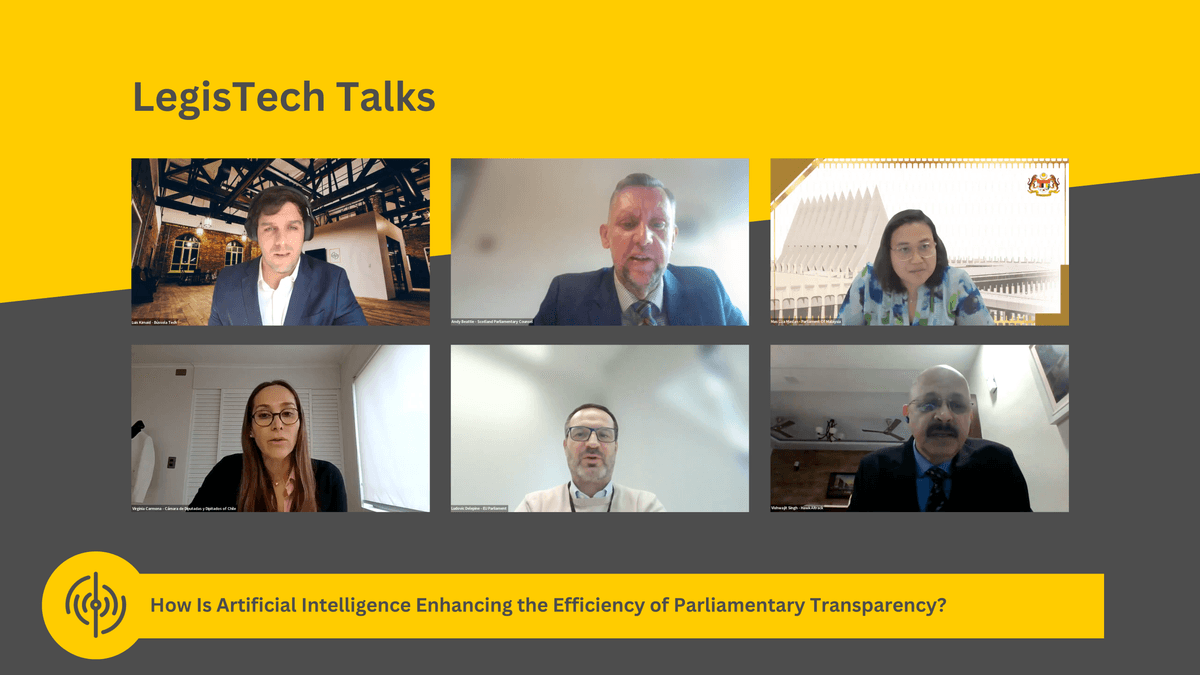
On December 11th, 2025, Bússola Tech convened a panel discussion titled “How Is Artificial Intelligence Enhancing the Efficiency of Parliamentary Transparency?”, bringing together senior parliamentary officials and technology specialists to examine how generative AI is reshaping legislative workflows, citizen access to information, and institutional transparency.
Moderated by Luís Kimaid, Executive Director of Bússola Tech, the panel brought together Andy Beattie, Chief Parliamentary Counsel of Scotland; Ludovic Delepine, Head of ICT at the European Parliament; Mas Liza Maslan, Researcher at the Parliament of Malaysia; Virginia Carmona, Deputy Director of Parliamentary Assignments at the Cámara de Diputadas y Diputados of Chile; and Vishwajit Singh, Partner at HawkAItrack (India).
The discussion focused on how artificial intelligence can move parliaments beyond static, portal-based transparency toward dynamic, conversational, and data-driven access to legislative information. Rather than treating AI as a novelty, participants examined its practical deployment across core parliamentary workflows, including transcription of debates, multilingual translation, semantic search across legislative archives, automated summarisation of bills and committee reports, comparative analysis of amendments, and AI-assisted citizen interfaces.
A central theme of the debate was efficiency with integrity. Panellists highlighted that AI can dramatically reduce the time required to process, classify, and retrieve parliamentary information. Real-time speech-to-text systems, AI-generated summaries, and contextual search tools allow both members and citizens to navigate complex legislative records more intuitively. However, these efficiency gains were consistently framed as conditional upon structured data, robust governance frameworks, and clearly defined human oversight mechanisms.
The panel also addressed the institutional challenges of transitioning from traditional digital portals to AI-powered conversational systems. Technical obstacles include data standardisation, integration with legacy systems, cybersecurity safeguards, and compliance with emerging AI regulatory frameworks. Equally significant are human and cultural challenges: building AI literacy among parliamentary staff, managing resistance to change, defining clear validation processes, and preserving professional judgment within automated environments.
Trust emerged as the defining concern. Participants emphasised that parliamentary transparency depends not merely on access, but on reliability, explainability, and auditability. AI systems must be grounded in verified legislative sources, provide traceable references to primary documents, and operate within clear ethical and governance structures. Human validation remains indispensable to ensure that outputs align with constitutional mandates and institutional standards.
Artificial intelligence was therefore examined not as a replacement for parliamentary expertise, but as an amplifier of institutional capacity. When embedded within structured legislative data environments and supervised by trained professionals, AI can enhance clarity, accelerate publication, improve multilingual accessibility, and broaden citizen engagement without compromising authority.
In conclusion, the panel reaffirmed that the efficiency of parliamentary transparency in the AI era depends on disciplined data governance, ethical oversight, and sustained institutional commitment. When deployed responsibly, artificial intelligence can transform how legislative knowledge is accessed and understood—strengthening openness while preserving the credibility and trust upon which democratic institutions depend.
Strategic Partners
Privacy Policy