


Panel Discussion about Step-by-Step on Creating a Committee on AI in Parliaments
How it was
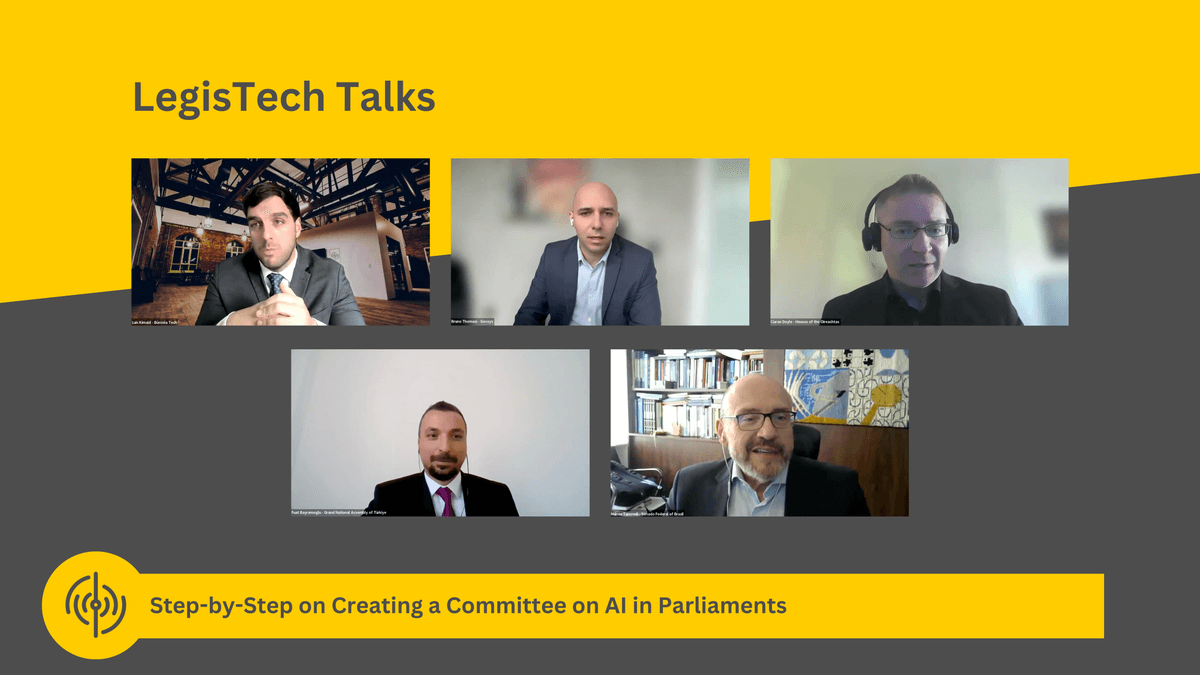
On October 29th, 2025, Bússola Tech convened a LegisTech Talks debate titled “Step-by-Step on Creating a Committee on AI in Parliaments”, bringing together senior parliamentary officials and institutional partners to examine how legislatures can structure, govern, and operationalize dedicated bodies to oversee artificial intelligence.
Moderated by Luís Kimaid, Executive Director of Bússola Tech, the panel brought together Fuat Bayramoglu, Legislative Expert of the Grand National Assembly of Türkiye; Ciaran Doyle, Assistant Secretary of the Houses of the Oireachtas; Márcio Tancredi, Executive Director of the Senado Federal of Brazil; and Bruno Thomasi, CEO of GovSys.
The discussion focused on why parliaments are increasingly creating dedicated committees, task forces, or working groups on artificial intelligence, and how these bodies can provide a structured space for strategic coordination across political leadership, parliamentary administration, and technical teams. AI committees were examined as mechanisms to elevate the discussion beyond isolated projects and embed artificial intelligence within institutional governance.
A central theme of the debate was the importance of treating AI not as a purely technical matter, but as a cross-cutting institutional issue involving legal frameworks, ethics, data governance, procurement, capacity-building, and political oversight. The panel emphasized that effective committees require clear mandates, defined scopes of action, and the ability to engage both internal parliamentary services and external expertise.
Participants also explored the composition and functioning of AI committees, highlighting the value of cross-party representation, administrative leadership, and technical expertise to ensure legitimacy and continuity. The discussion underscored that inclusive and representative structures help position AI as a shared institutional priority rather than a partisan or sector-specific initiative.
Significant attention was given to practical implementation strategies, including the use of pilot projects, phased approaches, and measurable criteria to guide decision-making and allow for timely course corrections. Committees were discussed as forums to balance innovation with risk management, ensuring that experimentation with AI remains aligned with parliamentary responsibility and democratic accountability.
The debate further examined how AI committees can contribute to broader digital maturity by fostering a culture of coordination, learning, and institutional alignment. Beyond overseeing individual projects, these bodies were framed as catalysts for long-term digital transformation, helping parliaments prepare for emerging technologies while reinforcing transparency, oversight, and public trust.
In conclusion, the panel reaffirmed that establishing a committee on artificial intelligence is not an end in itself, but a foundational governance step. When properly designed and integrated into existing institutional structures, such committees can help parliaments navigate the opportunities and risks of AI in a structured, accountable, and democratically grounded manner.
Strategic Partners
Privacy Policy