


Panel Discussion about The Strategic Role of AI in Enhancing Accountability in Parliaments
How it was
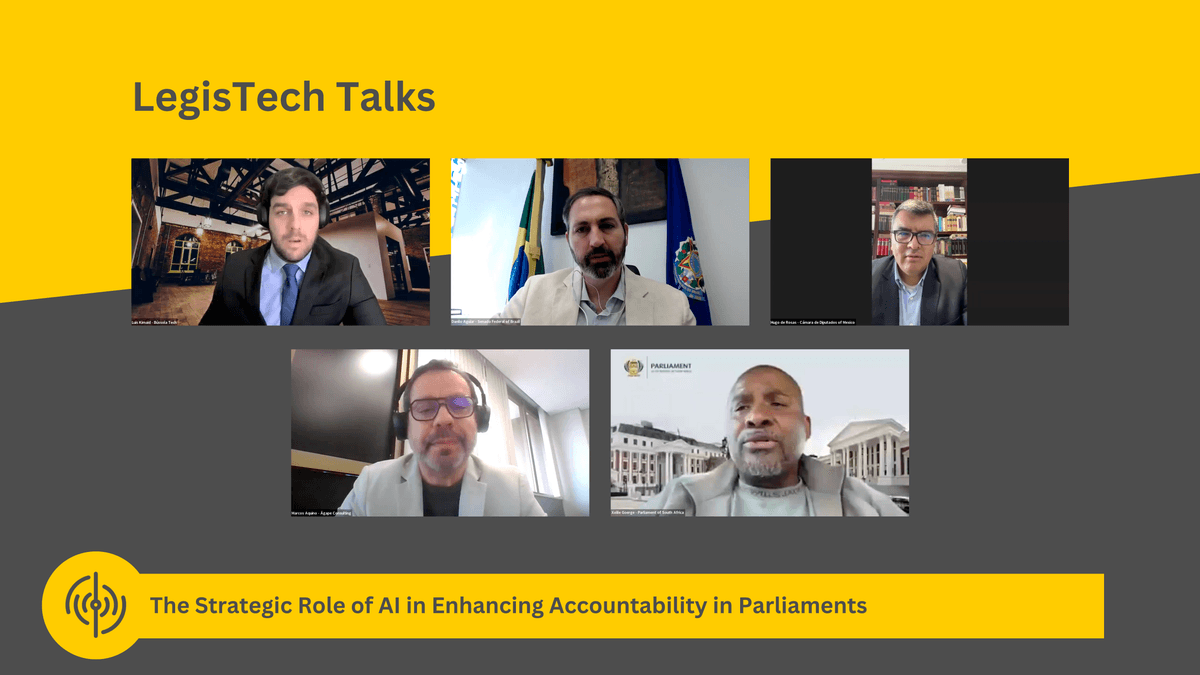
On August 22nd, 2025, Bússola Tech convened a high-level debate titled “The Strategic Role of AI in Enhancing Accountability in Parliaments”, bringing together senior parliamentary officials and institutional partners to examine how artificial intelligence can contribute to stronger accountability, transparency, and public trust in legislative institutions.
Moderated by Luís Kimaid, Executive Director of Bússola Tech, the panel brought together Danilo Aguiar, Secretary-General of the Federal Senate of Brazil; Hugo de Rosas, Secretary of Parliamentary Services of the Chamber of Deputies of Mexico; Xolile George, Secretary-General of the Parliament of South Africa; and Marcos Aquino, CEO of Ágape Consultoria.
The discussion centered on the premise that accountability in parliaments is not achieved solely through the publication of information, but through its intelligibility, accessibility, and contextualization. Artificial intelligence was examined as a tool capable of processing large volumes of parliamentary data and transforming them into usable, comprehensible information for citizens, legislators, and parliamentary staff, provided that its deployment is guided by clear governance principles.
A core theme of the debate was the distinction between instrumental use of AI and the preservation of parliamentary judgment and political responsibility. The panel emphasized that AI should support legislative, oversight, and participatory functions—such as data analysis, legislative comparison, information retrieval, and public-facing services—without replacing human deliberation, decision-making, or democratic accountability.
Participants also addressed the institutional and ethical risks associated with AI adoption in parliaments. These included the dangers of unchecked generative tools, disinformation, misuse of AI-generated content in political communication, and automated decision-making that could undermine legitimacy or public confidence. The discussion underscored the need for human oversight, explainability, traceability of sources, and safeguards to ensure that AI outputs remain aligned with verified parliamentary records.
Significant attention was given to the organizational and preparatory conditions required for responsible implementation. These included structured and reliable data, staff training, cybersecurity measures, regulatory clarity, and integration with existing parliamentary systems. The panel highlighted that AI adoption should follow a gradual, iterative approach, allowing institutions to test use cases, measure impact, and adjust governance frameworks over time.
The debate further explored how AI can enhance core parliamentary functions such as oversight and public participation, enabling more effective analysis of government performance, synthesis of public submissions, multilingual access to proceedings, and clearer communication of legislative activity. At the same time, it was emphasized that technology alone cannot resolve challenges of trust or legitimacy without corresponding institutional commitment and cultural change.
In conclusion, the panel reaffirmed that artificial intelligence should be treated as a strategic support tool embedded within democratic values, rather than a technological shortcut. Strengthening accountability through AI requires not only technical capability, but also sustained institutional governance, ethical responsibility, and a long-term vision that reinforces the role of parliaments as transparent, representative, and trusted democratic institutions in the digital era.
Strategic Partners
Privacy Policy