


Panel Discussion about the First Investments in Parliamentary Modernisation
How it was
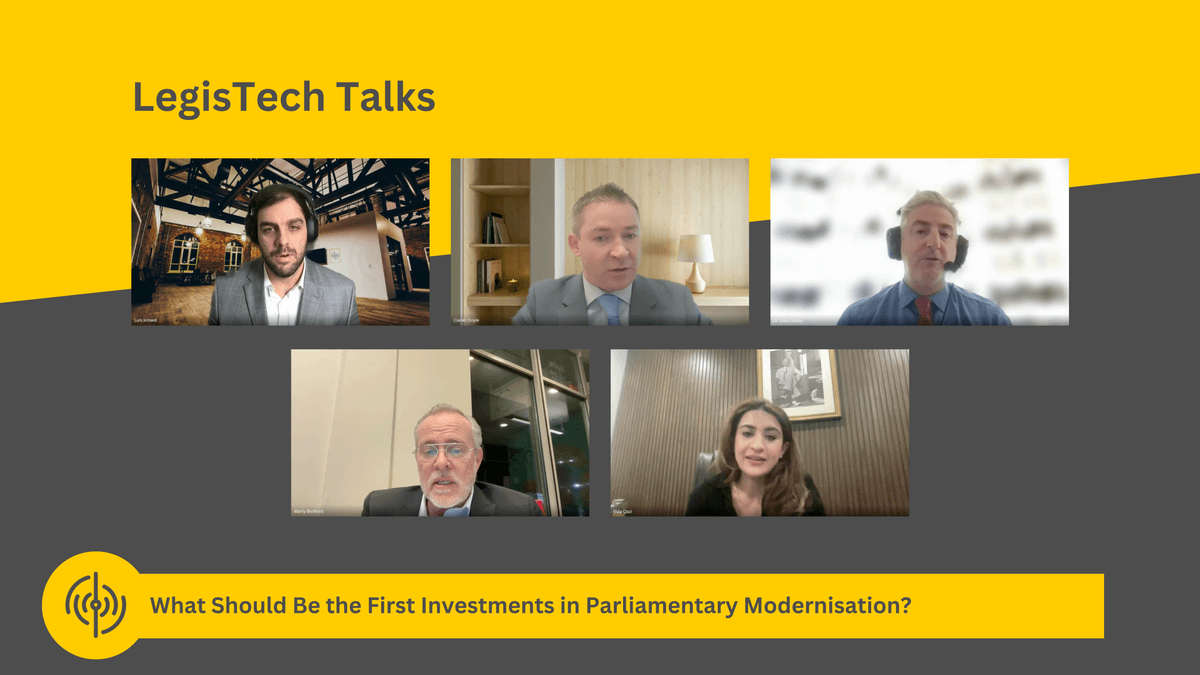
On February 11th, 2026, Bússola Tech convened a LegisTech Talks debate titled “What Should Be the First Investments in Parliamentary Modernisation?”, bringing together senior parliamentary leaders and technology specialists to examine how institutions can define foundational priorities before adopting new digital tools and artificial intelligence.
Moderated by Luís Kimaid, Executive Director of Bússola Tech, the panel brought together Ciaran Doyle, Assistant Secretary and CIO of the Houses of the Oireachtas (Ireland); Fotis Fitsilis, Head of Documentation and Research Service at the Hellenic Parliament (Greece); Rida Qazi, Special Advisor on Initiatives and Digital Transformation to the Senate of Pakistan; and Marty Bickford, Vice President at Xcential Legislative Technologies.
The discussion focused on what must precede technology in parliamentary reform. Rather than beginning with specific tools or AI applications, participants emphasized the importance of executive alignment, institutional clarity, enterprise-wide process mapping, and a shared strategic vision. Modernisation was framed as a long-term organisational transformation that requires mental preparation, cultural adaptation, and strong governance structures before any technical deployment.
A central theme of the debate was leverage: where should parliaments invest first to unlock downstream gains? Panellists highlighted people, data architecture, standards, identity and authentication systems, interoperable infrastructure, and program management capabilities as high-impact enablers. Early investments in structured data, enterprise architecture, and internal capacity were described as multipliers that strengthen subsequent waves of reform.
The panel also addressed the political reality of parliamentary institutions. Roadmaps must be designed to survive leadership turnover, shifting priorities, and electoral cycles. Participants discussed modular reforms, benchmarking against international peers, structured prioritisation frameworks, and clear governance models as mechanisms to ensure continuity without freezing innovation.
Artificial intelligence was examined within this broader institutional context. The discussion underscored that AI is not a substitute for foundational reform. Its effective and responsible use depends on prior decisions regarding data standardisation, document structure, interoperability, governance, and ethical safeguards. Preparing for AI means building systems that are coherent, reliable, and aligned with parliamentary mandates long before deploying advanced models.
In conclusion, the panel reaffirmed that parliamentary modernisation is not a sequence of technological upgrades, but a structural transformation rooted in strategy, governance, and institutional maturity. When first investments are carefully chosen and anchored in long-term vision, parliaments can create durable foundations that enable innovation, strengthen accountability, and responsibly integrate artificial intelligence into legislative work.
Strategic Partners
Privacy Policy